
Montessori Material Spotlight: Long Division with Racks and Tubes
Many adults may remember learning long division as a confusing sequence of steps to memorize and repeat (bring down, divide, multiply, subtract), often without a real sense of how it works and what division actually means. In Montessori classrooms, long division unfolds very differently.
Through the Golden Bead Material, Stamp Game, Small and Large Bead Frames, and Racks and Tubes material, children get to experience what division is. This article will focus on the material called “Racks and Tubes.”
Two Ways to Divide: Sharing and Grouping
Before introducing the material, we first clarify an important idea: there are two distinct kinds of division problems in real life.
One asks, “If I share this equally, how much does each person get?” This is partitive division, or division by sharing.
The other asks, “If I make groups of a certain size, how many groups can I make?” This is measurement division, or division by grouping.
The Racks and Tubes material focuses on partitive division. Children physically share quantities equally and discover what one share receives. Materials like the Stamp Game emphasize division of measurement. Together, these approaches give children a complete understanding of division and help them choose the strategy that best fits a given problem.
What Are Racks and Tubes?
The material is impressive and a little mysterious. Children are drawn to the material, both for its beauty and its complexity.
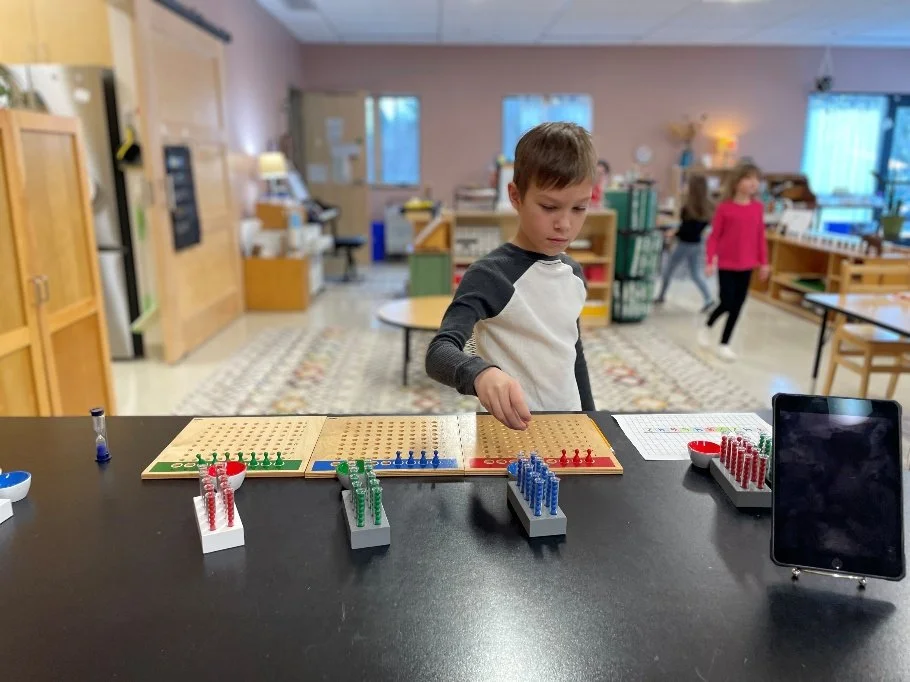
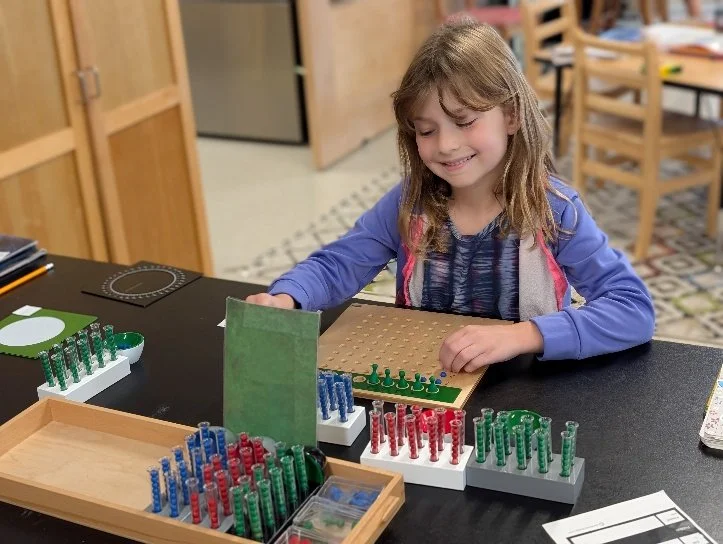
“Racks” hold test tubes filled with beads, color-coded by place value: units, tens, hundreds, thousands, all the way up to millions. This color coding mirrors that in previous activities the children have experienced. Matching cups hold the dividend (the number being divided). Boards and skittles represent the divisor (the number doing the dividing).
Every detail of the material reinforces place value. Each time children need to make an exchange, they trade in one bead of one category for ten of the next category (e.g., one hundred becomes ten 10’s). This process is visible and concrete.
Working with this material takes intentional focus. It takes time. It makes the steps of long division clear. It gives the child a physical memory of the steps.
How Long Division Becomes Concrete
When children solve a division problem with Racks and Tubes, they follow a logical, embodied process:
They build the dividend using the racks and cups.
They represent the divisor with individual figures on boards.
They share beads one at a time, equally, to each part of the divisor.
They stop when sharing is no longer possible and then see what remains from that category.
They then bring down the next category of beads to continue the sharing process.
Each step answers a real question:
What does one unit get?
What happens when we run out?
What do we do with what is leftover?
Instead of the instruction “bring down the next digit,” children physically bring down the next category of beads. When exchanges are required, children perform them physically by trading beads. Remainders are not mysterious leftovers. There are still beads sitting in the cup.
Long division becomes a story children can follow.
From Material to Abstraction
One of the most beautiful aspects of this work is how naturally it leads into abstraction.
First, children record only the quotient, the quantity obtained by dividing one quantity by another. Later, they begin recording intermediate remainders, the partial, temporary leftovers that occur during each step of a multi-digit long division calculation. Eventually, they discover that multiplying the quotient by the divisor tells them how much has been used at each step. This is the very heart of the traditional algorithm.
We do not give abstract shortcuts. Instead, we help children discover the pattern. This allows them to own the process, to understand the concept deeply.
By the time children are working abstractly on paper, the algorithm already makes sense. It matches what their hands have done repeatedly.
Why This Matters
The Racks and Tubes material does more than teach division. It teaches:
Deep place value understanding
Logical sequencing
Patience and precision
Trust in one’s own reasoning.
Most importantly, it gives children confidence. Division is no longer random numbers on paper. Instead, they can think through the process, step by step, with meaning and understanding.
In Montessori classrooms, math is not about getting the answer quickly. It is about building an understanding of why the process and answer makes sense. And with Racks and Tubes, long division does!